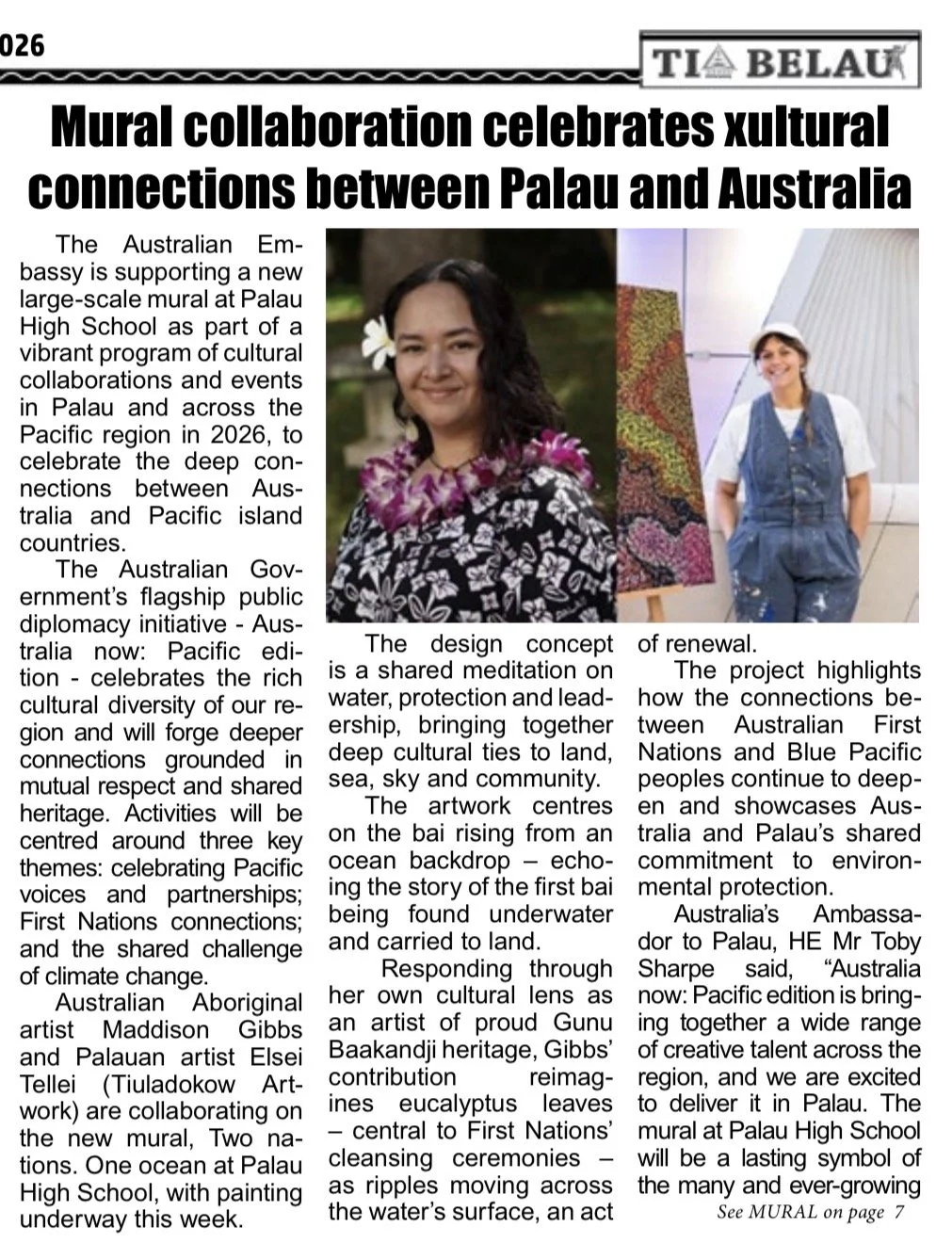
This mural is a shared meditation on water, protection, and leadership, brought together through two cultures united by a respect for the sea.
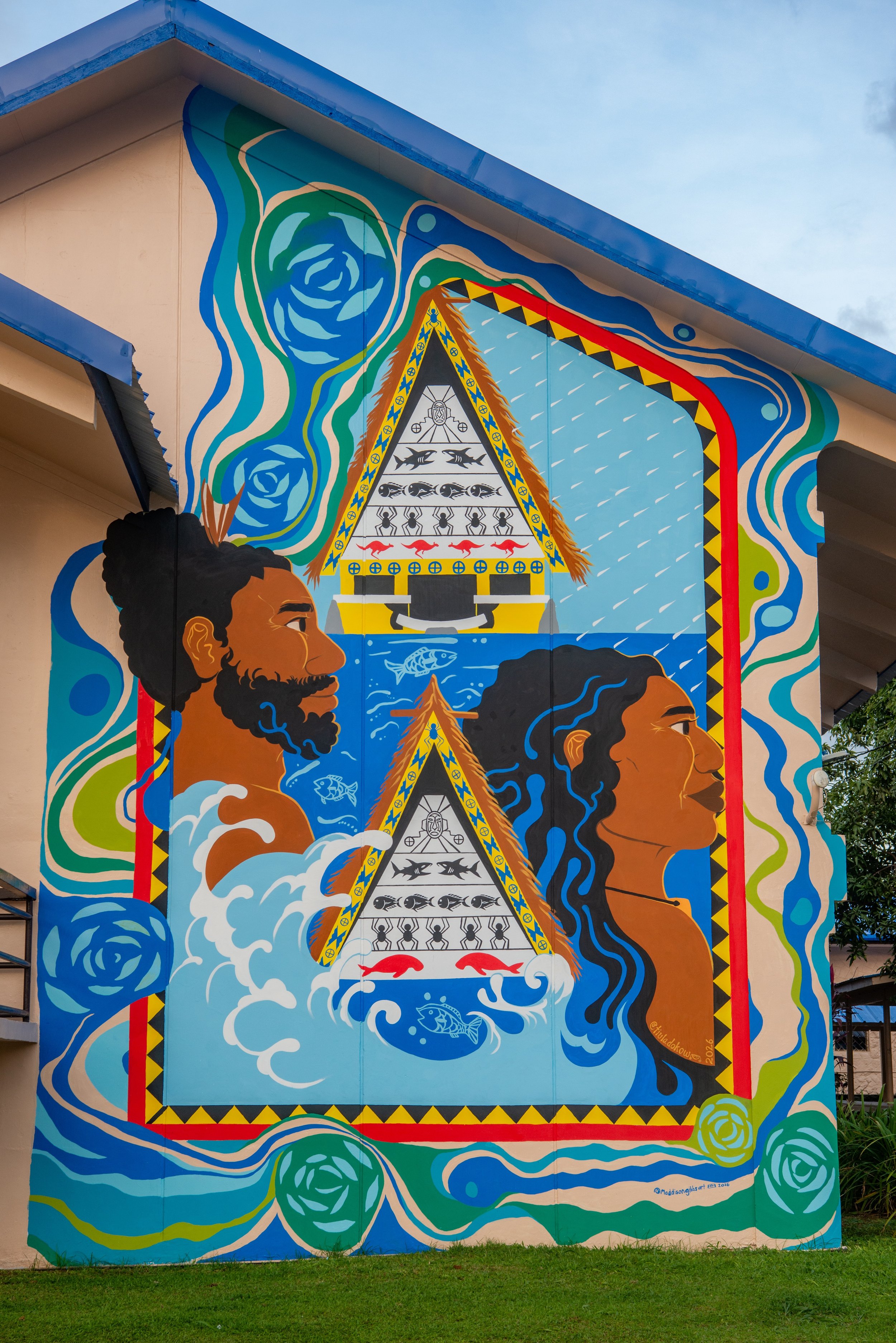
Elsei from Paulau depicts the bai, the culturally significant men’s meeting house, rising from an ocean backdrop — echoing a Palauan story of the first bai being found underwater and carried to land.
Maddi from Australia responds through her own cultural lens, reimagining eucalyptus leaves — central to a First Nations cleansing ceremony — as ripples moving across the water’s surface, an act of purification and renewal.
The two motifs overlap in meaning: the ripples also echo a Palauan saying that a good leader is like rain, calming the ocean.
Together, the works meet in the water itself — one culture’s story of shelter rising from the ocean, the other’s practice of cleansing carried across it — rendered as one unbroken surface connecting two island nations.
Your mural reimagines eucalyptus leaves as ripples across the water. How did that concept first come to you, and what drew you to connect these two elements? This motif comes from a healing ceremony that was shared with me. Eucalyptus leaves are dipped into water and spiralled over a person's head as a cleansing and healing practice. I wanted to honour that ceremony by transforming the leaves into ripples across the water, creating a visual language of healing. It also speaks to the deep relationship all First Nations peoples have with water. Water is life—it heals, connects us, and sustains everything.
This project brings together two island cultures through a shared respect for the sea. As you developed your work alongside Elsei’s, were there any unexpected parallels or shared values that stood out to you?One of the strongest connections was discovering how deeply both Aboriginal and Palauan cultures are rooted in water. Elsei shared the story of the Bai, the traditional chiefs' meeting house, which originated underwater. In my own culture, the Rainbow Serpent carved the waterways and is the creator spirit that shaped Country. Although our stories are unique, they both place water at the centre of creation, identity and belonging. The ocean has sustained both of our peoples for thousands of years, providing food, medicine and a way of life. Our connection to the sea isn't only spiritual—it's practical, cultural and intergenerational. I also like to think of water as holding memory. Every drop of water has travelled across landscapes, through oceans, clouds and rivers, connecting generations of people, plants and animals. In that sense, water carries an ancient wisdom that reminds us we are part of something much older and far greater than ourselves. That shared understanding of water as both life-giver and teacher became one of the strongest links between our cultures.
Collaboration often requires finding common ground while honouring each artist’s own cultural voice. How did you balance sharing your own perspective while responding to Elsei’s work? Elsei was incredibly generous throughout the process. We spent time sharing stories about our respective cultures, and rather than trying to make our work the same, we looked for the threads that connected them. Water became that shared language. It allowed each of us to celebrate our own cultural identity while creating something that felt unified and respectful of both traditions.
Water plays such a central role in this mural. What does water represent within your own cultural understanding, and how did you hope visitors would experience that through your artwork? For me, water is life. It is healing, connection and continuity. I believe water carries memory—it has moved through Country, oceans, rivers, plants, animals and people since time immemorial. Every drop connects us to those who came before us and those who will come after us. Whether understood spiritually or poetically, water reminds us that we are all interconnected and that caring for it is also caring for ourselves. I hope visitors experience a sense of calm and reflection, and leave with a deeper appreciation that water is not simply a resource, but something sacred that deserves our respect and protection.
What do you hope First Nations communities, the Palauan community, and the wider public take away from seeing these two stories woven together? I hope people leave with the understanding that, although our cultures have different stories, we are all connected by the ocean. Water doesn't recognise borders—it links us all. With that connection comes a shared responsibility to protect our oceans, rivers and waterways so future generations can continue to learn from and be sustained by them.
Was there a particular moment during the creative process that shifted your thinking or deepened your connection to the project? Meeting the Palauan people and experiencing the culture firsthand was the moment that truly deepened my connection to the project. As a visual artist—and a self-confessed mural addict—the first thing I noticed when I arrived in Palau was the incredible public art. From the airport the giant manta rays underneath the awning and onwards, murals celebrated the ocean, filled with fish, dugongs, giant clams, manta rays, stingrays and turtles. One of my favourite things was seeing the giant clam shells everywhere. They were piled outside restaurants as beautiful sculptural features and even embedded into concrete footings and architecture. I loved how something from the ocean was celebrated in everyday life, becoming both functional and decorative. It reflected a culture that doesn't separate itself from nature, but lives alongside it.It immediately told me that the sea wasn't just part of the landscape; it was woven into the identity of the people. Spending time swimming in the ocean, visiting the museum and listening to local stories gave me an even richer understanding of how central water is to Palauan life. everything seemed to return to the ocean—not only as a source of food and livelihood, but as a place of culture, identity, spirituality and community. That felt deeply familiar to me as an Aboriginal woman. Like our own connection to Country and waterways, the ocean in Palau is a living part of culture and everyday life. It was a privilege to experience that connection firsthand. It reinforced that, although our creation stories are different, both our cultures have been sustained by the ocean for thousands of years. Water nourishes us physically through the food it provides, but it also carries stories, memory and knowledge across generations. That shared understanding became the foundation of our collaboration and a reminder that water truly is life.
If you could describe this collaboration in three words, what would they be, and why? Meaningful, respectful and connected.It was meaningful because we were able to share our cultures openly with one another. It was respectful because the collaboration honoured both Aboriginal and Palauan cultural knowledge without compromising either voice. And it was connected because, through our shared relationship with water, we created a work that reflects the ties between our communities and reminds us of our collective responsibility to care for the oceans that unite us.
Your mural reimagines eucalyptus leaves as ripples across the water. How did that concept first come to you, and what drew you to connect these two elements? This motif comes from a healing ceremony that was shared with me. Eucalyptus leaves are dipped into water and spiralled over a person's head as a cleansing and healing practice. I wanted to honour that ceremony by transforming the leaves into ripples across the water, creating a visual language of healing. It also speaks to the deep relationship all First Nations peoples have with water. Water is life—it heals, connects us, and sustains everything.
This project brings together two island cultures through a shared respect for the sea. As you developed your work alongside Elsei’s, were there any unexpected parallels or shared values that stood out to you?One of the strongest connections was discovering how deeply both Aboriginal and Palauan cultures are rooted in water. Elsei shared the story of the Bai, the traditional chiefs' meeting house, which originated underwater. In my own culture, the Rainbow Serpent carved the waterways and is the creator spirit that shaped Country. Although our stories are unique, they both place water at the centre of creation, identity and belonging. The ocean has sustained both of our peoples for thousands of years, providing food, medicine and a way of life. Our connection to the sea isn't only spiritual—it's practical, cultural and intergenerational. I also like to think of water as holding memory. Every drop of water has travelled across landscapes, through oceans, clouds and rivers, connecting generations of people, plants and animals. In that sense, water carries an ancient wisdom that reminds us we are part of something much older and far greater than ourselves. That shared understanding of water as both life-giver and teacher became one of the strongest links between our cultures.
Collaboration often requires finding common ground while honouring each artist’s own cultural voice. How did you balance sharing your own perspective while responding to Elsei’s work? Elsei was incredibly generous throughout the process. We spent time sharing stories about our respective cultures, and rather than trying to make our work the same, we looked for the threads that connected them. Water became that shared language. It allowed each of us to celebrate our own cultural identity while creating something that felt unified and respectful of both traditions.
Water plays such a central role in this mural. What does water represent within your own cultural understanding, and how did you hope visitors would experience that through your artwork? For me, water is life. It is healing, connection and continuity. I believe water carries memory—it has moved through Country, oceans, rivers, plants, animals and people since time immemorial. Every drop connects us to those who came before us and those who will come after us. Whether understood spiritually or poetically, water reminds us that we are all interconnected and that caring for it is also caring for ourselves. I hope visitors experience a sense of calm and reflection, and leave with a deeper appreciation that water is not simply a resource, but something sacred that deserves our respect and protection.
What do you hope First Nations communities, the Palauan community, and the wider public take away from seeing these two stories woven together? I hope people leave with the understanding that, although our cultures have different stories, we are all connected by the ocean. Water doesn't recognise borders—it links us all. With that connection comes a shared responsibility to protect our oceans, rivers and waterways so future generations can continue to learn from and be sustained by them.
Was there a particular moment during the creative process that shifted your thinking or deepened your connection to the project? Meeting the Palauan people and experiencing the culture firsthand was the moment that truly deepened my connection to the project. As a visual artist—and a self-confessed mural addict—the first thing I noticed when I arrived in Palau was the incredible public art. From the airport the giant manta rays underneath the awning and onwards, murals celebrated the ocean, filled with fish, dugongs, giant clams, manta rays, stingrays and turtles. One of my favourite things was seeing the giant clam shells everywhere. They were piled outside restaurants as beautiful sculptural features and even embedded into concrete footings and architecture. I loved how something from the ocean was celebrated in everyday life, becoming both functional and decorative. It reflected a culture that doesn't separate itself from nature, but lives alongside it.It immediately told me that the sea wasn't just part of the landscape; it was woven into the identity of the people. Spending time swimming in the ocean, visiting the museum and listening to local stories gave me an even richer understanding of how central water is to Palauan life. everything seemed to return to the ocean—not only as a source of food and livelihood, but as a place of culture, identity, spirituality and community. That felt deeply familiar to me as an Aboriginal woman. Like our own connection to Country and waterways, the ocean in Palau is a living part of culture and everyday life. It was a privilege to experience that connection firsthand. It reinforced that, although our creation stories are different, both our cultures have been sustained by the ocean for thousands of years. Water nourishes us physically through the food it provides, but it also carries stories, memory and knowledge across generations. That shared understanding became the foundation of our collaboration and a reminder that water truly is life.
If you could describe this collaboration in three words, what would they be, and why? Meaningful, respectful and connected.It was meaningful because we were able to share our cultures openly with one another. It was respectful because the collaboration honoured both Aboriginal and Palauan cultural knowledge without compromising either voice. And it was connected because, through our shared relationship with water, we created a work that reflects the ties between our communities and reminds us of our collective responsibility to care for the oceans that unite us.